
4 min read
As promised in last week’s post, I am sharing with you an overview of my investment portfolio and how it’s shaping up as of March 2024. My aim is to provide monthly updates so you can see how my portfolio evolves over time and gather insights from my experiences along the way.
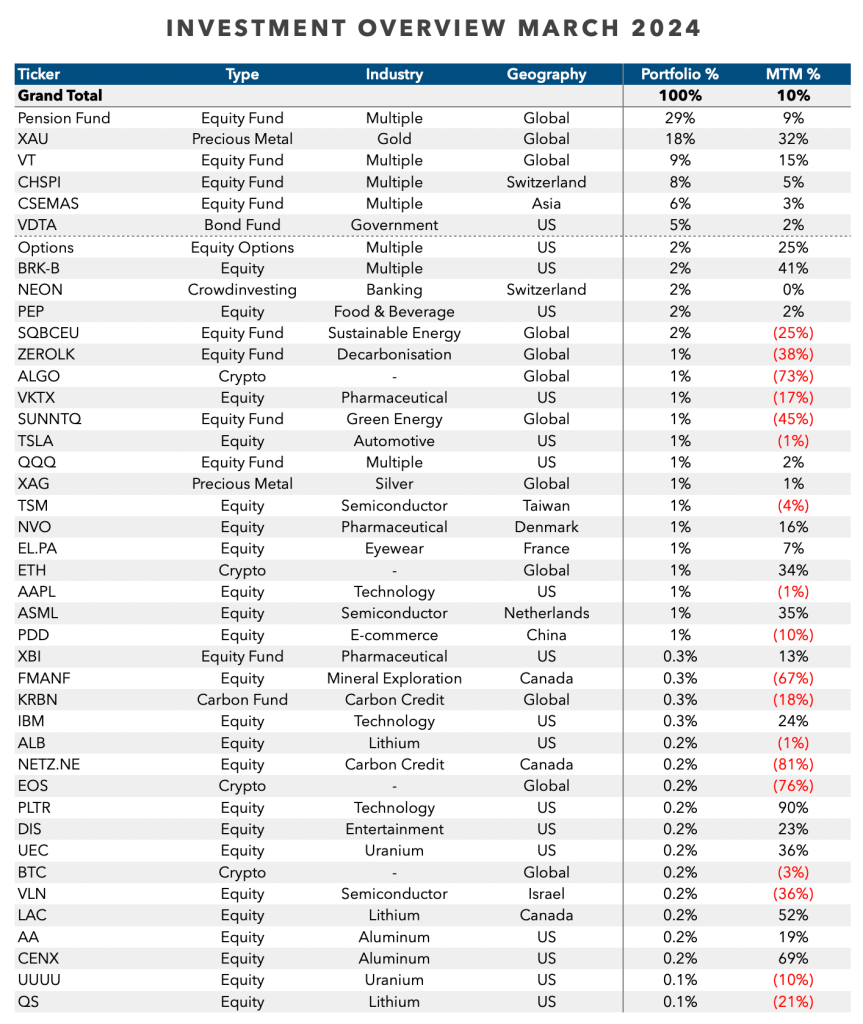
Let’s dive right in. Below, you’ll find a breakdown of each security in my portfolio, including its type, industry, geography, % weight, and % mark-to-market value (MTM), reflecting unrealized profit or loss.
Allocation Overview:
The bulk of my portfolio, approximately 60%, is allocated to funds, where I’ve been seeing the majority of my positive returns. As I’ve discussed in previous posts, globally diversified equity funds have been my go-to choice for long-term investing. They offer stability and consistent returns as the global economy grows. They have proven to be invaluable, especially when navigating volatile market conditions.
Picking individual stocks or even industries can be challenging, and diversified funds prove to be quite handy. As a real-life example, I also have more industry-specific funds focusing on green energy, but unfortunately, they are yielding negative returns. With the onset of the Russia-Ukraine war and soaring European energy prices, I anticipated this would catalyze a transformation in the energy industry, given the global discussions on climate change. I expected more countries to support renewable business models and focus on limiting carbon emissions through measures like taxing carbon (i.e., carbon credits). However, this scenario hasn’t unfolded as I envisioned, at least not yet. Nevertheless, I remain bullish on the long-term prospects of the green energy sector, holding onto these investments in anticipation of future growth.
Hedging Strategies:
To hedge against economic uncertainty, I’ve allocated a portion of my portfolio to precious metals, primarily gold. Gold serves as a reliable investment during times of economic turmoil, preserving its value or even increasing it. While the value of gold may be influenced by various factors, including industry demand and investor sentiment, I haven’t explored academic papers analyzing data to understand which one is more relevant. However, it could be an interesting topic for future posts.
Additionally, I’ve started investing into US Treasury Bond ETFs since the summer of 2023, anticipating potential interest rate decreases in 2024 and beyond. These bonds could provide a protective buffer against market fluctuations. Based on recent news, there’s a high possibility of interest rate cuts starting as of summer 2024, and I’m considering purchasing even more until then.
Stock Picks and Growth Opportunities:
While funds form the backbone of my portfolio, I also maintain a diverse selection of individual stocks. I’ve tried to identify industries poised for significant growth in the future and targeted related stocks accordingly. Industries such as semiconductors (if AI becomes the new industrial revolution), pharmaceuticals (with a focus on weight loss drugs due to the increasing obesity rates globally), and lithium (for solid-state electric vehicle batteries) have caught my attention.
As you can see, the portfolio weight of stocks is relatively low compared to other instruments, and their returns vary. Although they often yield a higher percentage return than diversified funds, the direction of the return is unpredictable. My total stock portfolio shows a net positive return, but this is attributed to adopting a long-term investor mindset and diversifying across multiple stocks within potential growth industries.
Lessons Learned:
Of course, I also have learned from my negative returns. For example, I have held onto my losses for longer than I should have with stocks. For funds, I have no problem holding them for longer periods of time; after all, that’s why I buy them. However, with stocks, I also seek short to medium-term returns, so I should have been more determined to sell stocks with more than 50% negative MTM.
Another lesson learned is that I should be more cautious when purchasing stocks that have experienced drastic increases in value over a short period of time. Stocks with lower trade volumes tend to be more volatile, as their value can fluctuate rapidly (e.g., based on the latest earnings report). Therefore, I should time my purchases better, avoiding periods of high volatility such as during quarterly earnings announcements but rather considering purchasing them during the quarter.
One might wonder why I didn’t buy stocks like Amazon, Google, Microsoft, or Nvidia, but opt for picks in other industries. The answer is, I already have exposure to them through my equity funds. Also, I missed my chance when they were relatively cheaper and think they are quite expensive at the moment. Hence, I’m diversifying my portfolio further by taking chances with less common industries, potentially discovering good picks along the way.
Never put all of your pastéis on the same tray.
 Thirteenth Salary
Leave a comment